

The Best Litter-Box Setup for Senior Cats
A litter box that worked perfectly for years may become difficult for a senior cat to use.
Arthritis, muscle loss, weakness, reduced vision, cognitive changes, kidney disease, diabetes, digestive problems, and other age-related conditions can affect how easily a cat reaches, enters, and uses the box.
A few thoughtful adjustments can make the litter box safer and more comfortable—and may help you notice health or mobility changes sooner. Also check out our ABC’s of Litter Boxes.
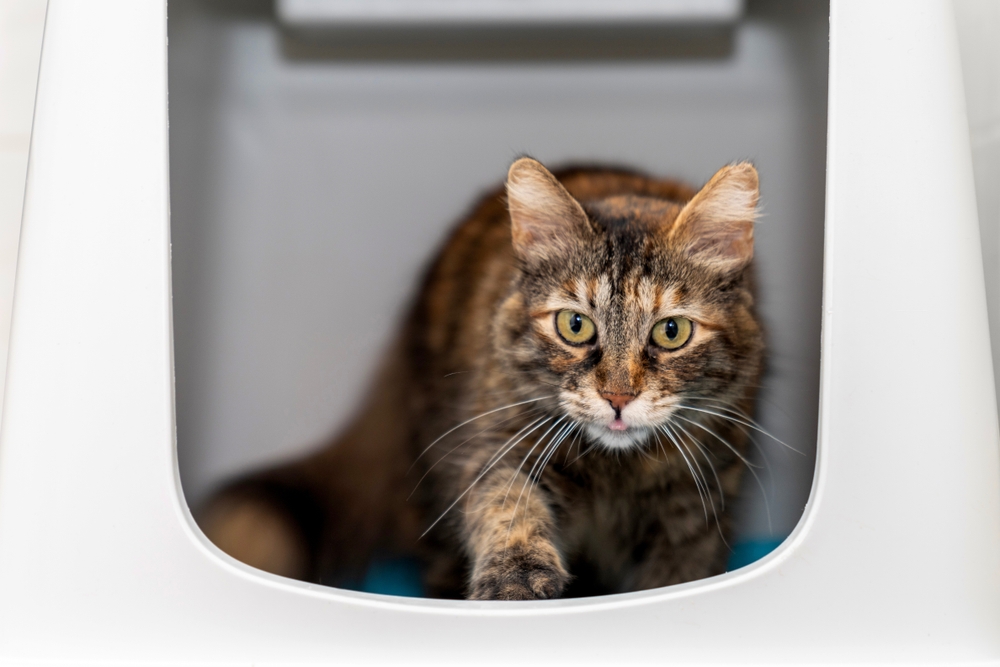
Begin With a Low Entry
A senior cat should not have to climb or jump over a tall wall to use the litter box.
Choose a box with:
- A low entrance on at least one side
- Enough room to enter and turn comfortably
- A stable base that does not shift or tip
- Higher walls on the remaining sides if your cat tends to scatter litter or urinate over the edge
A shallow storage container or under-bed bin can sometimes work well if the opening is low and all edges are smooth. Some families modify a plastic box by creating a lower doorway, but they must carefully smooth and cover any cut edge to prevent injury.
The entrance should be low enough to reduce strain without being so shallow that litter and waste spill constantly onto the floor.
Bigger Is Usually Better
Cats need room to enter, turn around, dig, and choose a position without pressing against the sides.
Many commercial litter boxes are too small, particularly for large cats. As a general guide, the box should be approximately one-and-a-half times the cat’s body length, excluding the tail.
Senior cats may need even more room to maneuver because stiffness can make tight turns uncomfortable.
Place Boxes Where Your Cat Lives
Do not make an older cat cross the house or climb stairs whenever nature calls.
Provide:
- At least one box on every level your cat uses
- A box near the cat’s preferred sleeping and living areas
- An unobstructed route
- A quiet location that does not feel isolated
- Distance from food and water
- An alternative route if another pet could block access
The usual starting recommendation is one box per cat, plus one additional box if possible. Senior cats may need more because accessibility matters as much as the total number.
Avoid placing the only box in a basement, behind a heavy door, beside a loud appliance, or in an area where a dog or another cat can ambush the user.
Add Nonslip Footing
A cat may reach the box successfully but struggle on a slick floor.
Place a nonslip mat or runner along the approach and around the box. The surface should provide traction without catching claws or sliding under the cat’s feet.
If you use a litter-catching mat, choose one that is soft, stable, and easy to cross. Deep, heavily textured mats may be uncomfortable for cats with painful paws or unsteady movement.
Use a Comfortable, Familiar Litter
Many cats prefer a fine, soft, unscented clumping litter. Strong fragrances and abrupt texture changes can discourage use.
For a senior cat:
- Continue using a familiar litter when possible.
- Avoid heavily perfumed products.
- Provide enough litter for digging without making it excessively deep or unstable.
- Introduce any change gradually.
- Consider whether rough pellets or large crystals may be uncomfortable beneath sensitive paws.
If you want to try a different litter, offer it in an additional box rather than abruptly replacing every familiar box.
Covered or Uncovered?
An uncovered box is often easier for a senior cat to enter, turn around in, and escape from if startled. It also lets you monitor urine and stool more easily.
Some cats, however, prefer the privacy of a cover. Choose the one your cat will use comfortably.
If using a covered box, make sure it is large, well-ventilated, and easy to enter. Remove swinging doors or flaps if they create resistance or make your cat hesitant.
Provide Gentle Lighting
Vision can change with age, and a dark hallway or basement may become difficult to navigate.
A plug-in night-light can help illuminate:
- The route to the box
- Stairs or ramps
- The entrance
- Nearby obstacles
Lighting should be gentle rather than glaring. The goal is to make the area easier to navigate without placing a bright light directly over the box.
Keep the Box Especially Clean
Senior cats may become less willing or able to maneuver around soiled areas.
Scoop at least daily—and more frequently in multi-cat households or when a cat urinates more because of kidney disease, diabetes, medication, or increased water consumption.
Wash the box periodically with mild, unscented soap and water. Avoid harsh fragrances that may discourage use.
Monitoring the box also helps you notice:
- Larger or more frequent urine clumps
- Smaller clumps or reduced urination
- Diarrhea or constipation
- Blood
- Straining
- Changes in frequency
What About Automatic Litter Boxes?
Automatic boxes may reduce daily scooping, but they are not ideal for every older cat.
Potential concerns include:
- A high entrance
- A small interior
- Movement or noise
- Steps that are difficult to climb
- Delayed detection of changes in urine or stool
- Difficulty entering or turning with arthritis
If your senior cat already uses an automatic box happily, there’s no reason to remove it. Consider also providing a low-entry conventional box so your cat has an accessible alternative.
Ramps and Steps Can Help—But Keep Them Stable
A short ramp may help when a box cannot have a sufficiently low entrance. It should be wide, gently sloped, nonslip, and firmly secured.
Steep ramps and narrow steps can be harder than the original obstacle. Observe how your cat moves rather than assuming an adaptation is helping.
Accidents Are Not Spite
A senior cat who begins eliminating outside the box is communicating that something has changed.
Possible causes include:
- Arthritis or pain
- Constipation or diarrhea
- Urinary disease
- Kidney disease
- Diabetes
- Hyperthyroidism
- Weakness
- Vision loss
- Cognitive dysfunction
- Stress or conflict with another cat
- Difficulty entering or reaching the box
- A negative association caused by painful elimination
Do not punish your cat. Schedule a veterinary examination, particularly when the change is sudden or repeated.
Seek urgent care if your cat repeatedly strains, cries in the box, produces little or no urine, vomits, becomes weak, or appears distressed. Inability to urinate is an emergency.
Let Your Cat Help Design the Setup
Experiment by setting up more than one accessible option and observe:
- Which box your cat chooses
- Which entrance height is easiest
- Preferred litter depth and texture
- Whether a cover is accepted
- Whether certain locations are avoided
- How comfortably the cat enters, turns, squats, and exits
The best senior-cat litter box is not necessarily the most attractive or technologically advanced. It is the one your cat can reach and use comfortably every time.
Thoughtful environmental changes can protect independence and dignity as a cat ages. If your senior cat stops jumping, struggles with stairs, or begins having litter-box accidents, contact your family veterinarian. Oakland Veterinary Referral Services works with pet parents and primary veterinarians to evaluate complex mobility, neurologic, and age-related health concerns.